Preparing for the Quantum Era: A Practical Roadmap

File 2 of 3: What business leaders should do today, who to talk to, and why it cannot wait.
Prepared June 2026
A note on where this is coming from. I am not a physicist. I got into technology in 1984, the year of the Mac, and spent my career learning how to make complex systems legible to the people who have to make decisions about them. That’s the only credential I’m bringing here.
What I found, as I worked through the physics of understanding quantum, is that the concepts are genuinely accessible if someone who has already struggled through them does the translation honestly, without oversimplifying and without performing expertise they don’t have. I'll try to do that here, and yes, with the help of my AI thought partner, Claude.
The one-paragraph version
You do not need a quantum strategy. You need a quantum-aware security plan, a short list of informed conversations, and a small standing capability to watch this space. The security work is urgent because the threat to your encrypted data is already active. The opportunity work is important but patient. Most leaders get this backwards, chasing speculative use cases while leaving the actual exposed flank, their cryptography, unexamined.
Why you should care: the cybersecurity clock is running
Every confidential piece of data your company transmits or stores (contracts, financials, customer data, IP, M&A discussions) is protected by public-key cryptography. A sufficiently powerful quantum computer breaks that math. The industry calls the arrival of such a machine Q-Day, and current expert estimates of Q-Day’s arrival cluster within the next five to ten years, with timelines compressing as investment accelerates.
The trap is thinking Q-Day is the deadline. It is not. Adversaries are running harvest-now-decrypt-later (HNDL) operations today: capturing encrypted traffic, storing it cheaply, and waiting for the math to catch up. If your data needs to stay confidential for seven to ten years (and contracts, health records, financials, and trade secrets all do), the deadline for protecting it has effectively already passed.
This is why governments are not waiting:
The US requires federal agencies to adopt post-quantum cryptography, with full transition of quantum-resistant protocols targeted by 2030. NSA rules require new national security acquisitions to be quantum-safe compliant starting January 1, 2027.
The EU expects critical infrastructure to complete migration of high-risk systems by 2030 and full migration by 2035. The UK, Japan, and South Korea have published similar 2030 to 2035 road maps. The G7's cyber group recommends critical financial systems migrate by 2030 to 2032.
The private sector is moving on its own clock: Google announced in March 2026 that it pulled its internal post-quantum migration deadline forward to 2029, and Apple already ships post-quantum protocols in iMessage.
Here’s why a $50 million company should care about federal mandates that do not name it: compliance flows downhill.
If you sell to government, to defense contractors, to banks, to healthcare systems, or to anyone who sells to them, quantum-safe requirements will appear in your contracts and security questionnaires within the next two to three years. Some already have. The companies that did the inventory work early will check the box; the rest will lose deals while they scramble.
So let’s look at the roadmap.
Track one: defense (start this quarter)
The federal cybersecurity agencies have published a clear migration playbook. CISA's post-quantum initiative and NIST’s PQC program are the canonical sources; NIST finalized the first quantum-resistant encryption standards in August 2024, so this is no longer waiting on standards.
Here’s the mid-size version of a migration playbook:
Inventory your cryptography.
You cannot migrate what you have not mapped. Identify where your organization uses public-key encryption: VPNs, websites, email, code signing, payment systems, stored archives. Most mid-size companies discover this data lives almost entirely with vendors, which simplifies the job considerably. Expect this to take a quarter, not a week.
Classify data by lifespan.
Ask one question of every data category: how long does this need to stay secret? Anything with a confidentiality horizon past roughly 2032 is already at risk from harvest-now-decrypt-later collection and goes to the top of the migration list.
Push the question to your vendors.
For most companies your size, post-quantum migration is largely a procurement exercise. Add two questions to every renewal and security review:
What is your post-quantum cryptography migration timeline?
Which NIST PQC standards do you support today?
Vendors with no answer are telling you something.
Demand cryptographic agility in anything new.
Any system you build or buy from now on should be able to swap encryption algorithms by configuration, not code rewrite. This single procurement requirement is the cheapest insurance available in this entire transition.
Track two: offense (start within twelve months)
McKinsey’s guidance for business leaders, laid out in its 2026 Quantum Technology Monitor, pairs the defensive work with a deliberately modest offensive play.
Adapted for mid-size organizations:
Map two or three candidate use cases.
Quantum advantage will land first in simulation, optimization, and risk: scheduling, routing, asset allocation, materials and formulation problems, complex financial modeling. If classical computing limits are not actually holding back anything in your business, write that down too. A documented “not yet, and here is what would change our mind” is a legitimate strategic position.
Name a translation function, even if it is one person.
Large companies are building two-to-five person translation teams tied to their AI units, tasked with evaluating quantum use cases and coordinating pilots. The mid-size equivalent is one technically fluent person (often whoever owns your AI roadmap) who holds the watching brief, reads the two or three sources in File 3, and reports to leadership twice a year. The point is ownership, so the topic does not evaporate between headlines.
Use quantum-as-a-service for any experiments.
If a use case looks real, pilot through cloud platforms Amazon Braket, IBM Quantum, Microsoft Azure Quantum at pay-per-use prices. No hardware, no hires, modest budget. The goal of an early pilot is learning and benchmark-honesty: always compare results against the best classical compute approach before believing a quantum claim.
Who to talk to, in order
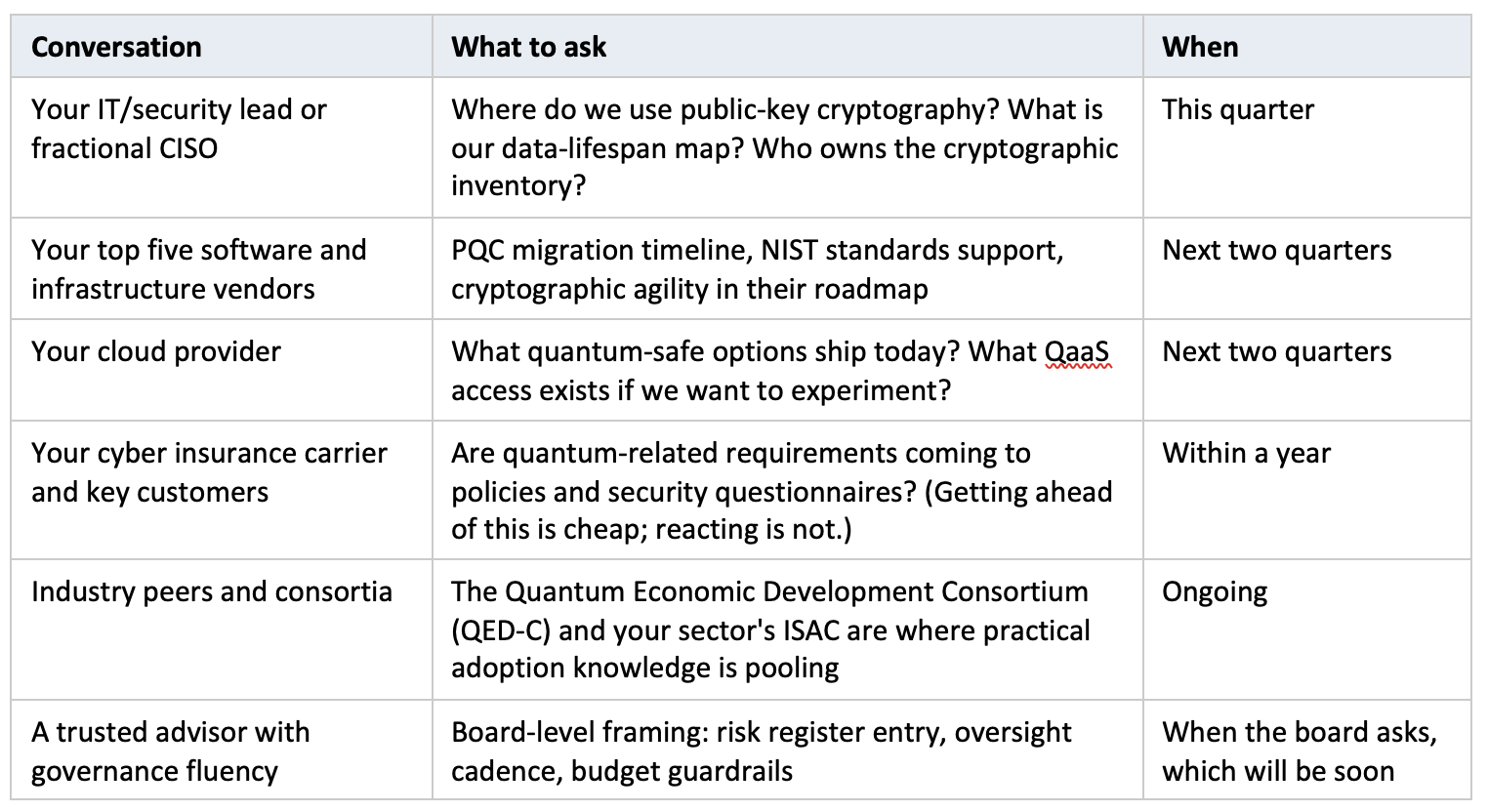
The Quantum Economic Development Consortium, or QED-C deserves a specific mention: it is the US industry consortium for quantum, includes hundreds of member organizations, and is one of the few places where mid-size companies can access the same adoption intelligence the giants have.
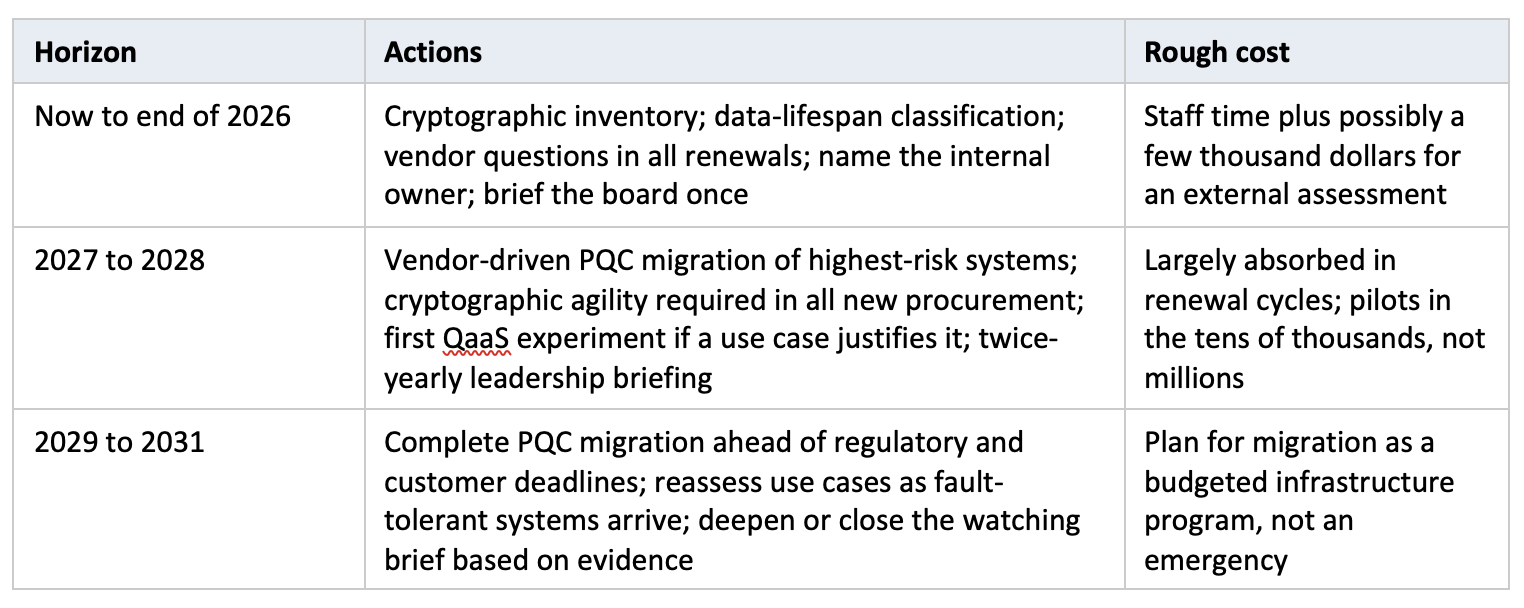
A timeline that respects your actual budget
What not to do
Do not buy hardware, hire quantum physicists, or fund speculative R&D. That is not your role in this ecosystem, and the vendors who suggest otherwise are selling something.
Do not wait for Q-Day certainty. The mandated migration happens on government and customer timelines whether or not the machines arrive on schedule. Inaction is a decision, and it is the expensive one.
Do not let this become a science project. Every quantum conversation in your company should end with a business question: what data are we protecting, what problem are we solving, what did the benchmark show?
The bottom line: treat quantum the way disciplined leaders treated cloud in 2010 and AI in 2020. The companies that did modest, early, structured preparation looked prescient three to five years later. They were not prescient. They were just paying attention while it was still cheap to do so.
This is File 2 of 3 in The Quantum Briefing.
File 1:The Quantum Decade: Reading 2036 From 2026
File 3: Quantum Computing: A Curated Resource Guide
Don’t leave your AI or quantum journey to chance.
Connect with us today for your AI adoption support, including AI Literacy training, AI pilot support, AI policy protection, risk mitigation strategies, and developing your O’Mind for scaling value. Schedule a bespoke workshop to ensure your organization makes AI work safely and advantageously for you.
Your next step is simple. Let’s talk together and start your journey towards safe, strategic AI adoption and deployment with AIGG.